Human-Centred Learning in the Age of AI: A Conversation with Dr Lilit Sargsyan
Updated: Mar 15

In this edition of Global Voices in Language Education, we are honoured to speak with Dr. Lilit Sargsyan, Associate Professor and Chair of English Language No. 2 at the Faculty of European Languages and Communication at Yerevan State University. With nearly three decades of experience in higher education, Dr. Sargsyan’s work bridges linguistics, pedagogy, and educational policy. Her research and professional engagement span Comparative Typology, Neurolinguistics, student-centred learning, and the human-centred integration of artificial intelligence in higher education. In this conversation, she reflects on her academic journey, innovation in teaching, and the evolving future of language education in the era of Industry 5.0. | 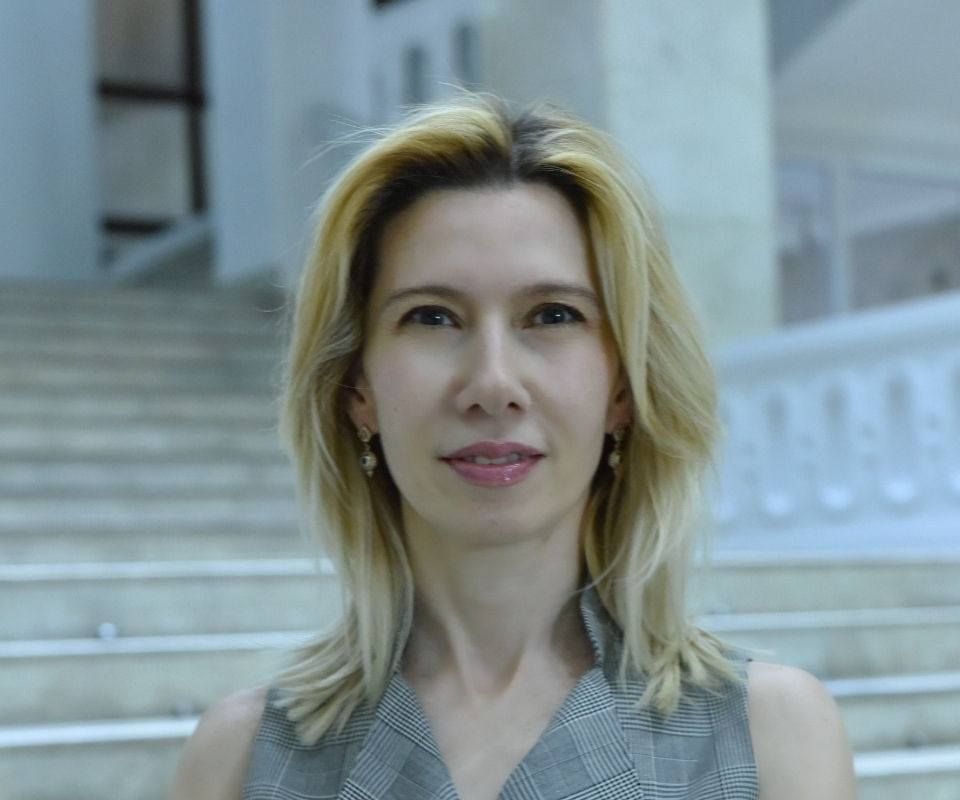 |
1. With over 26 years of experience in language education and 15 years in teacher training facilitation, how would you describe the evolution of your academic and professional journey?
When I joined Yerevan State University in 1998, my primary focus was on linguistic content and effective classroom delivery. Over time, I came to understand that how we teach matters as much as what we teach, and that realisation has shaped much of what I have done since. It was not a sudden shift but a gradual one, driven by experience, commitment to YSU, and, of course, by the professional development opportunities I have been fortunate to encounter along the way.
My Cambridge CELTA qualification in 2015 deepened my engagement with learner-centered methodologies. Participation in the British Council's Teacher Mentoring programme in 2018, followed by the ERASMUS+ PRINTeL project, opened up new perspectives on digitally-enhanced and collaborative learning that I have tried to bring back into my own practice. Each of these experiences added something, and I am grateful for them.
Since 2017, I have integrated problem-based and project-oriented approaches into my courses, inviting students to engage with real-world challenges, such as fair trade, sustainability, and, more recently, questions around AI and technology, while developing their language competencies. From 2022, this expanded to include green big data and green IT concepts, creating genuinely interdisciplinary learning environments. My years in teacher training facilitation have reinforced the conviction that professional learning must be ongoing and reflective, which is something I try to model in my own practice as much as I advocate for it in others.
2. How has your PhD in Philology shaped your engagement with Comparative Typology, Morphology, and broader linguistic inquiry?
My doctoral research at RUDN University, completed in 2002, gave me a rigorous grounding in comparative and structural linguistics that continues to inform my thinking. Comparative Typology trained me to observe patterns across languages and to ask why certain morphological and syntactic features recur across unrelated families. This has formed into a habit of mind that I find useful not only in research but in the classroom, where it helps me anticipate the specific challenges Armenian-speaking students encounter with English.
Over time, my interests have expanded into Neurolinguistics and Psycholinguistics to deepen my understanding of how learners actually process and retain language. This has influenced my course design in concrete ways: I draw on evidence around Spaced Learning and memory consolidation, for instance, when structuring practice activities and building in time for consolidation.
For me, these theoretical domains and my pedagogical practice are in ongoing conversation. My published work, including a 2018 paper on lexicality and grammaticality in morphemes and a 2021 piece on blending innovative learning methods, reflects that integrative orientation. I do not consider theory as separate from practice, but rather a part of how I think about what I am doing in the classroom and why.
3. Receiving the YSU Teaching Excellence Award is a significant recognition. What principles underpin your approach to excellence in teaching and learning?
Receiving the Teaching Excellence Award in 2021 was a genuinely moving moment, an affirmation that some of what I have been trying to build over the years was perhaps on the right track.
A few principles run through my teaching. The first is keeping students genuinely at the center by designing tasks that are meaningful and connected to real issues. The second is methodological breadth: I draw on a range of methods, including Flipped Classroom, World Café discussions, Inquiry-Based Learning, and Case-Based analysis, trying to adapt them to the profile and needs of the specific group of learners.
The principle that perhaps I feel most strongly about is that I try to remain a learner myself. My own continuous professional development feeds directly into my teaching, and I think students can sense when their instructor is genuinely curious and still growing. Whether that makes as much difference as I hope is harder to say, but it is something I return to over and over again.
4. In your role as the RA Representative of the BFUG Working Group on Learning & Teaching, how do you perceive the intersection between policy frameworks and classroom realities?
Serving as Armenia's representative to the Bologna Follow-Up Group's Working Group on Learning and Teaching from 2021 to 2024 was one of the most formative experiences of my career. Participating in meetings and panel discussions among the EHEA representatives gave me a much wider view of how educational policy is developed, contested, and implemented, and how wide the gap between policy intent and classroom reality can be.
What I observed is that frameworks articulating Student-Centered Learning, Skills-Based education, or Microcredentials are often thoughtfully developed, but their implementation depends on contextual factors that policymakers do not always fully account for: institutional culture, resource availability, faculty readiness, and assessment traditions. The same policy can produce very different outcomes in different settings.
My role as national representative was to work in both directions: bringing European discourse and good practices into Armenia’s Higher Education conversations, and ensuring that the realities of a smaller, less-resourced system were heard in European policy discussions.
5. Your scholarly interests span Comparative Typology, Morphology, Neurolinguistics, and Psycholinguistics. How do these domains inform your understanding of language acquisition and pedagogy?
These fields, in my experience, are more deeply connected than they might first appear, and their integration has been central to how I think about language teaching. Comparative Typology has helped me understand why certain features of English present particular challenges for speakers of typologically distant languages such as Armenian. I have used this knowledge to design explanations, sequence material, and anticipate points of difficulty. Morphology attunes me to the building blocks of meaning and their role in both comprehension and production.
Neurolinguistics and Psycholinguistics add the dimension of the learner's mind. Research on memory consolidation, on how emotional engagement enhances encoding, and on attentional constraints has influenced my instructional choices in concrete ways. Spaced Learning, for instance, distributing practice across time rather than concentrating it, is grounded in psycholinguistic evidence about long-term memory formation, and I have found it genuinely useful in course design.
What interests me most is that these theoretical domains increasingly converge with findings from cognitive science and AI research. My published work reflects this integrative orientation. Thus, theory, for me, is more of a lens for examining and improving practice.
6. How can insights from neurolinguistics and psycholinguistics contribute to more effective adult education and skills-based learning environments?
Adult learners present a distinct and fascinating challenge. They bring rich prior knowledge and experience, strong motivational profiles, and often considerable anxiety about re-entering a learning environment. Psycholinguistic research suggests that adults benefit from seeing the relevance of what they are learning, from connecting new knowledge to existing experience, and from having meaningful autonomy in the learning process.
My training in adult education through the DVV International programme in 2023 helped me articulate more systematically the ideas I had been applying more intuitively. Working memory constraints, for instance, suggest that adult learners should not be overwhelmed with too much new material at once, which supports chunked instruction, scaffolding, and regular consolidation. These insights translate into concrete course design decisions: sequencing, task complexity, and the rhythm of input and output.
In skills-based environments, the key is designing tasks that are cognitively engaging without being overloading. These tasks connect to learners' existing knowledge and goals while stretching them toward new capacities. My use of Moodle, interactive video, and AI-assisted platforms reflects an attempt to create learning environments that are both neurologically informed and pedagogically purposeful.
7. You advocate for Student-Centered Learning and Active Learning approaches. What theoretical foundations support these methodologies in higher education?
Student-Centered Active Learning draws upon a substantial theoretical heritage. Constructivism, particularly in its Vygotskian form, holds that knowledge is not transmitted but constructed through collaboration on problem-based projects and analysis of real cases. By means of facilitating structured discussions, students are constructing knowledge actively and socially in ways that tend to stick.
Self-Determination Theory offers motivation, helping learners thrive when they experience autonomy, competence, and relatedness. Students’ needs are best met when educators design courses that challenge them at the right level, as well as foster real collaboration among participants. My work within the ERASMUS+ PRINTeL framework, using the ADDIE instructional design model, gave me more structured tools for implementing and evaluating these approaches.
More recently, I have been working with Hardman's Post-AI Learning Taxonomy, which offers a framework for thinking about learning outcomes in an era when AI can perform many of the lower-order cognitive tasks traditionally assigned to students. This shifts emphasis toward higher-order thinking, ethical reasoning, and collaborative sense-making.
8. You have presented internationally on learning in the era of Industry 5.0. How do you conceptualise the role of higher education institutions within this rapidly evolving socio-technological landscape?
Industry 5.0 represents a shift from the efficiency-driven logic of Industry 4.0 toward a more human-centric, sustainable, and resilient model of socio-economic organisation. For higher education, this carries real implications. Universities can no longer limit themselves to merely transmitting knowledge; they need to cultivate graduates who are agile, ethically aware, and capable of operating meaningfully within complex technological environments.
In my 2024 paper presented at the Annual Conference on Shaping the Future of European Dual Higher Education in Malta, I explored how Armenia’s HEIs are beginning to embrace Industry 5.0 principles, albeit unevenly. The challenge is not simply technological adoption, but a deeper reorientation of educational purpose towards not only the development of students’ knowledge and skills, but also preparing them to become future-proof citizens.
9. What are the pedagogical implications of AI-facilitated personalised and cohort-based learning?
The distinction between personalised and cohort-based learning becomes particularly interesting in the context of AI. AI tools can, in principle, offer a degree of personalisation in a form of adaptive content delivery, real-time feedback, and customised pacing, which is a good way of meeting diverse learner needs, which is something I have been experimenting with through various AI tools as a part of inquiry-based research.
However, in my experience, personalization, when implemented at the expense of collaborative, cohort-based learning, reduces student engagement and motivation. In my 2025 paper in the European Journal of Open, Distance and E-Learning, I examined how to balance guided instruction with collaborative learning for the simultaneous development of critical thinking and language skills. The findings suggest that the richest learning emerges at the intersection of AI-facilitated individual support and structured peer interaction.
10. How can educators maintain human-centered values while integrating advanced technologies into the learning process?
I believe we can find the answer by examining the degree of intentionality in the integration of AI into the learning process. If technology is deployed to achieve educational values such as fostering inquiry, scaffolding complex thinking, and expanding students’ access to knowledge, then I consider this learning approach strategic and, surely, beneficial for learners.
The ethical dimensions of AI use have become a significant thread in my teaching. Engaging students in discussions about Agentic AI systems, which are capable of making autonomous decisions, and their implications for education, work, and society, has led me to investigate the possible integration of Agentic AI in higher education, which I explore in my 2025 paper on this topic.
11. Drawing on your experience in teacher training facilitation, what competencies are most urgently needed among contemporary educators?
Fifteen years of working with educators across different career stages has given me a reasonably clear sense of where the most significant gaps tend to lie, though to avoid making any generalizations, I must mention that my observations are mostly shaped by the YSU context.
Given today’s context of continuous technological disruption, it is very difficult for educators to evolve from being a transmitter of knowledge and skills developer to a facilitator and tech-savvy instructional designer. My involvement in the ERASMUS+ eCAMPUS programme as a trainer is oriented precisely toward supporting colleagues in developing digital competencies and AI literacy among YSU colleagues.
12. You are currently engaged in an EU-funded Training of Trainers (TOT) programme focused on fostering critical thinking in higher education. Why is critical thinking particularly urgent at this historical moment?
Even though critical thinking development has always been a pivotal goal in education, AI disruption has erected serious barriers to it. The ease and speed of content generation lead to superficial learning outcomes.
The EU-funded course on critical thinking development for YSU lecturers and administrative staff, developed in collaboration with my colleague Serob Khachatryan, was an attempt to address this at the institutional level. We drew on frameworks including Paul and Elder's Critical Thinking model, the RED method (Recognize, Evaluate, Design), and De Bono's Six Thinking Hats to give participants both conceptual tools and practical strategies they could apply in their own AI-enabled teaching.
My 2024 paper on fostering critical thinking in Armenian higher education in the age of AI-driven transformation documents some of what emerged from this work.
13. What structural or cultural shifts are required within universities to genuinely embed student-centred and skills-based learning?
Genuine embedding requires change at multiple levels simultaneously, which is what makes it so difficult and so slow. From what I have observed, assessment systems reward memorisation and reproduction, overlooking the process of learning. Therefore, diversifying assessment, such as project-based work and reflective assignments are a structural prerequisite for change.
Workload is another factor that tends to be underestimated. Student-centered skills-based learning is more demanding than traditional delivery; it requires more preparation, more responsive facilitation, more feedback, and if institutions do not recognise this and provide efficient support systems, innovation in teaching will become the personal burden of each educator. This is not merely a matter of institutional commitment but rather a cultural shift in universities. It also requires peer learning communities where educators can share both successes and failures honestly, and genuine recognition of teaching excellence alongside research productivity.
14. What major transformations do you foresee in language education and higher education more broadly over the next decade?
Predicting the future of education is something I prefer to approach carefully. Nonetheless, it is safe to say that some tendencies seem clear enough to reflect on.
In language education specifically, AI tools that provide real-time scaffolding are already making interesting changes in language learning. I think we will see more developments in this direction. Therefore, language teachers will have to focus more on the dimensions that AI handles less well, such as nuance, cultural and relational awareness, and ethical expression.
I expect the expansion of micro-credentialling and modular learning pathways to continue, gradually transforming traditional degree structures and asking universities to think more flexibly about how learning is recognised and valued.
What I hope for is that Higher Education will find ways to remain a space for deep, sustained inquiry, along with it becoming more agile to change.
15. What advice would you offer to emerging academics who wish to balance research excellence, pedagogical innovation, and policy engagement?
My first suggestion would be to resist the artificial separation of research, teaching, and policy engagement, as in my experience, they complement each other.
I would also encourage emerging academics to actively seek international connections, as the exposure to international practice positively challenges assumptions that are hard to notice from within one’s own system.
And finally, I’d advise them to be resilient: there will be years when one dimension is seemingly more important, and others are neglected, and when the balance seems impossible. That is simply the reality of an academic career, and it is worth accepting rather than being discouraged by it.
16. What continues to inspire and sustain your commitment to advancing Learning & Teaching at both institutional and international levels?
After more than 28 years of teaching, I won’t hesitate to say that my learners’ expectations and the whole Yerevan State University community are what challenge me, feed my energy, and make me a lifelong learner.
I remain genuinely curious about the questions related to how people learn language, how technology reshapes cognition and learning, and what critical thinking requires of us in this particular moment. That curiosity, more than anything else, is what motivates me to experiment and self-develop.



Comments