Transforming ESP Case Preparation through ChatGPT

Aleksandra Łuczak holds a PhD in English and has taught legal and business English at Kozminski University since 1997. Since 2019, she has headed the Centre for Foreign Language Teaching and coordinates the TOLES and Linguaskill Exam Center. She has authored numerous publications and teaching materials on legal English and frequently trains language teachers at conferences and workshops. Łuczak has received ten Kozminski University Rector’s Awards for innovation in teaching. She also runs an online English language school and the PER SE publishing house. |  |
This interview explores key perspectives on teacher education, highlighting the role of research, reflective practice, and digital innovation in shaping effective pedagogy.
Introduction
Case studies have proven to be a highly effective teaching method in English for Specific Purposes (ESP) courses, fostering greater motivation and engagement among students (Caroux, 2025). By placing learners into realistic, discipline-relevant scenarios, the case study method enables them to actively solve problems, make decisions, and apply concepts in practical contexts (Tsymbal & Volkova, 2024; Ates & Esteban, 2012). Research demonstrates that students exposed to case-based approaches in ESP not only improve their language proficiency but also develop critical thinking, problem-solving, collaboration and analytical skills essential for their future careers. Notably, studies show that over 80% of students report significant improvements in critical thinking, decision-making, and problem-solving skills after engaging with case study methods, highlighting the efficacy of this approach (Al-Mahdi, 2023; Ates & Esteban, 2012; Tsymbal & Volkova, 2024).
AI as a Vital Tool for ESP Case Study Development
In the fast-evolving landscape of ESP education, teachers face the challenge of keeping case studies relevant and up-to-date. Published coursebooks, while valuable, rapidly become outdated due to changing professional contexts and industry-specific developments. Artificial Intelligence (AI), including tools like ChatGPT, offers a powerful solution by enabling ESP teachers to quickly generate tailored, accurate, and contextually relevant case studies. Collaborating with AI saves educators time and effort, allowing them to focus more on pedagogy and personalized learner support.
Using ChatGPT to Create Effective Case Studies for ESP Classrooms
ChatGPT can serve as an effective assistant for ESP teachers in developing case studies. I have been experimenting with AI and mostly ChatGPT since it was launched at the end of 2022. I consider it a very efficient teaching assistant without which it is hard to imagine my daily ESP practitioner’s routine. Recently I have implemented the following structured steps to create an up-to-date case study that resonates with the realities of Gen Z students.
1. Find an article you want to base your case study on
Select a suitable article to base your case study on. This could be a recent publication by university faculty or an up-to-date article you have read or have asked ChatGPT to find for you. For this article, I have asked ChatGPT to find an up-to date article on a topic similar to one from the 2018 Pearson publication Business Partner B2, Unit 1, which discusses Investment Banks' Work-Life Balance Schemes. ChatGPT compiled a list of four different articles out of which I selected Madison Davis text on Prevent Financial Resignation (2025).
2. Ask ChatGPT to write a prompt for you (sic!)
Engage ChatGPT in drafting a detailed prompt for your case study. My original prompt was:Write a prompt for the following:
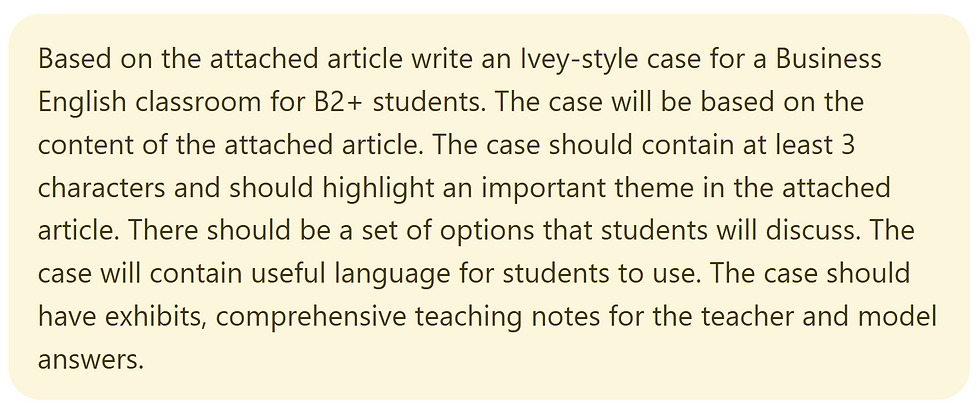
I have decided to use Ivey style because it emphasizes active, experiential learning through concise, decision-focused cases. This approach places students in the role of decision-makers, requiring them to analyze key issues, develop alternatives, and defend their recommendations, thereby fostering critical thinking and practical problem-solving skills. In contrast, Harvard cases tend to be longer and more detailed, presenting extensive background information and encouraging individual analysis before group discussion.
Studies show that refining and iterating prompts substantially improve AI output relevance and accuracy. For instance, research from Latitude (2025) demonstrates that iterative prompt refinement can boost accuracy by up to 30% and reduce bias by 25%. These findings emphasize that clear, well-structured prompts – revised and tested for optimal performance – lead to more precise, efficient, and reliable AI-generated content.
The details of the procedure and the after version of the prompt can be found on my blog.
3. Prompt ChatGPT to write a case study
Use the prompt generated with ChatGPT and upload the relevant article(s) you wish to base the case study on. By selecting the Deep Search function, you enable ChatGPT to conduct multi-step, in-depth research using online sources and attachments, resulting in much more comprehensive output than the standard mode. In practice, the standard ChatGPT produced a concise three-page case study, while Deep Search generated a highly detailed twenty-page report, clearly illustrating the difference in depth and scope. The complete, ready-to-use case study, exploring talent retention challenges in Summit Bank during the era of Great Resignation 2.0, with Teacher’s Notes and model answers, is available here:
1. Teachers’ handout
2. Students’ handout 1 (pre-class)
3. Students’ handout 2 (in-class).
4. Create a GPT model to play one of the characters
To make the Summit Bank case more engaging for quiet or hesitant students, a dedicated GPT model can be created to take on the role of one key character in the scenario. In this class, the model represents David Weiss, a senior executive who is highly authoritative, confident, and composed, and who consistently uses formal, precise business English and is intentionally difficult to convince. During the role play, students use their smartphones and conduct a meeting with “David,” played by the GPT model and the remaining roles taken by students. The David Weiss model used in this activity is available at bit.ly/Summit_David_Weiss.
Teaching with case studies drawbacks
Teaching with case studies requires motivated and engaged students. Such detailed case studies require extensive reading on the part of the student and before class preparation if the class you teach is 90-minute long. If you have longer time slots available, you can assign reading related articles before class and then divide the case study reading into manageable bits at the beginning of your class. Such solution is more feasible, as the teacher will be certain that all students are familiar with the content of the case study before they start interacting.
References
Al-Mahdi, S. (2023). The role of case study methods in enhancing critical thinking skills among university students. Journal of Educational Research, 12(3), 45-60. https://files.eric.ed.gov/
Ates, O., & Esteban, A. A. (2012). Impact of case study method on an ESP business course. International Journal of Business and Social Science, 3(9), 264-271. http://www.iiis.org
Caroux, C. (2025). Maximizing learning potential: The role of case studies in the ESP classroom. Universidad Politécnica de Cartagena Repository. https://repositorio.upct.es



Comments